By Spyridoula Dimitropoulou | Research Assistant at Agricultural University of Athens (AUA)
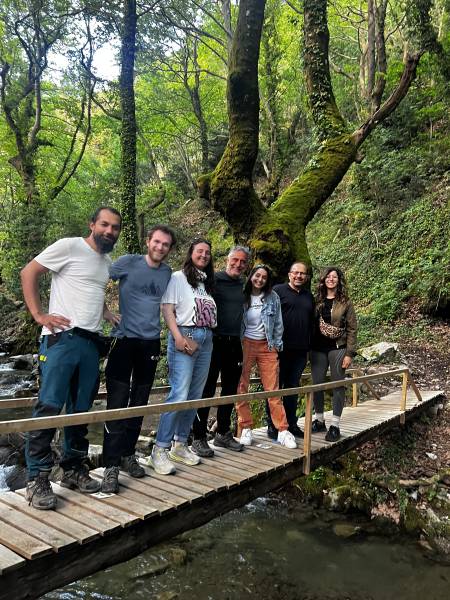
From 16-17 May 2026, a two-day field campaign was conducted on Evia Island, focusing on the areas of Mantoudi and Steni Dirfyos. These sites were selected because they represent different stages of disease development in plane tree populations, allowing for meaningful comparison and analysis of infection dynamics.
The activity was carried out as a synergy action between the EU Horizon projects STELLA project et FORSAID project, with the common objective of strengthening integrated approaches for the early detection and monitoring of canker stain disease caused by Ceratocystis platani affecting plane trees. By combining expertise in forest health monitoring, remote sensing, and data-driven analysis, the synergy contributes to the development of coordinated surveillance strategies across project frameworks.
UAV-Based Data Acquisition and Methodology
The fieldwork focused on UAV-based data acquisition using hyperspectral and multispectral sensors, supported by systematic ground-truth observations. This combined methodology enables a more robust assessment of vegetation condition and disease expression, while also improving the ability to detect subtle spectral differences associated with varying infection stages.
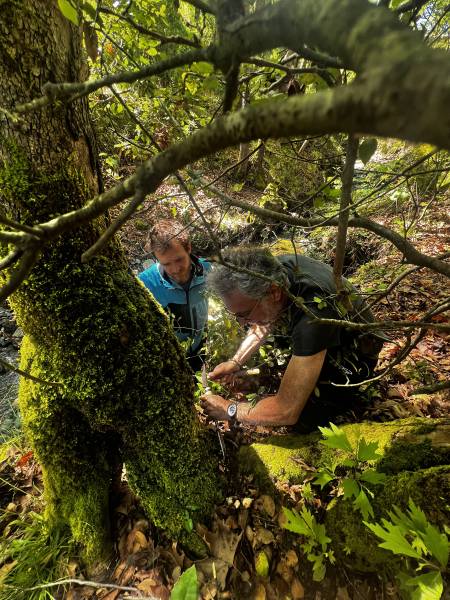
In the Mantoudi area, surveys were conducted across three predefined plots within an established Use Case Pilot (UCP) of the STELLA project. These plots represent a clear gradient of health conditions, ranging from healthy stands to heavily infected plane trees. UAV flights were carried out to collect high-resolution spectral imagery, while plant pathologists from each team simultaneously recorded ground observations, visible symptoms, and collected samples to support validation and interpretation of the remote sensing data.
On the second day, activities continued in Steni Dirfyos and surrounding areas, where the first confirmed infections were recorded in 2025. Compared to Mantoudi, this site reflects an earlier stage of disease emergence, offering important insight into initial spread patterns. Additional scouting in nearby locations further supported the assessment of disease presence across a broader landscape context. Together, these sites provide complementary datasets for understanding both early and advanced stages of infection.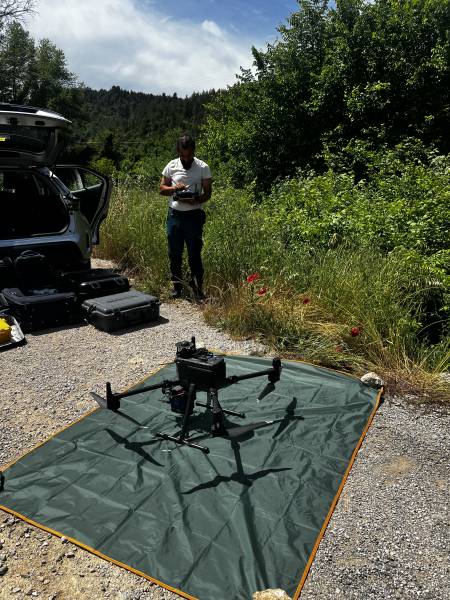
Stakeholder Engagement and Dissemination
Beyond data collection, the field campaign also served as a demonstration and dissemination activity. Local stakeholders, including representatives from the Forest Service and citizens from nearby communities, participated in discussions on forest disease monitoring and related management challenges. This engagement fostered knowledge exchange between research teams and practitioners, while also raising awareness of the ecological and socio-economic impacts of Ceratocystis platani.
Collaboration and Next Steps
The Evia Island field campaign represents only the first step in an ongoing scientific collaboration between the STELLA project and the FORSAID project, yet it already demonstrated how productive and complementary this partnership can be. The joint activity brought together expertise in forest pathology, remote sensing, and UAV-based monitoring, enabling a seamless integration of methodologies and a shared approach to data collection and ground validation. This close field-level cooperation proved particularly valuable for aligning protocols, improving consistency in observations, and strengthening the overall quality and comparability of the datasets, while also fostering meaningful exchange of know-how between teams under real operational conditions. Beyond the technical outcomes, the collaboration enhanced mutual understanding of each project’s objectives and working practices, reinforcing a common framework for future joint activities. Building on this foundation, the next steps will focus on further harmonizing methodologies and integrating UAV and field datasets into unified analytical and modelling workflows to support improved early detection of Ceratocystis platani, ultimately strengthening shared efforts towards the protection and management of vulnerable plane tree ecosystems.