

STELLA’s Policy Work progresses toward actionable recommendations for the digitalisation of Phytosanitary Governance, amid Agricultural Policy Evolution
By Green & Digital
In January 2025, the amended EU Plant Health Law (Regulation (EU) 2024/3115) took effect, introducing streamlined reporting through digitalisation, a Union Plant Health Emergency Team, and new phytosanitary certificate requirements for regulated non-quarantine pests (RNQPs). These amendments confirm a direction that STELLA identified early on: the EU’s plant health framework is progressively embracing digital tools and data-driven approaches to strengthen phytosanitary governance. As the project moves into its most intensive policy phase, STELLA’s policy work, led by Green & Digital, is now translating collected evidence into actionable policy recommendations.
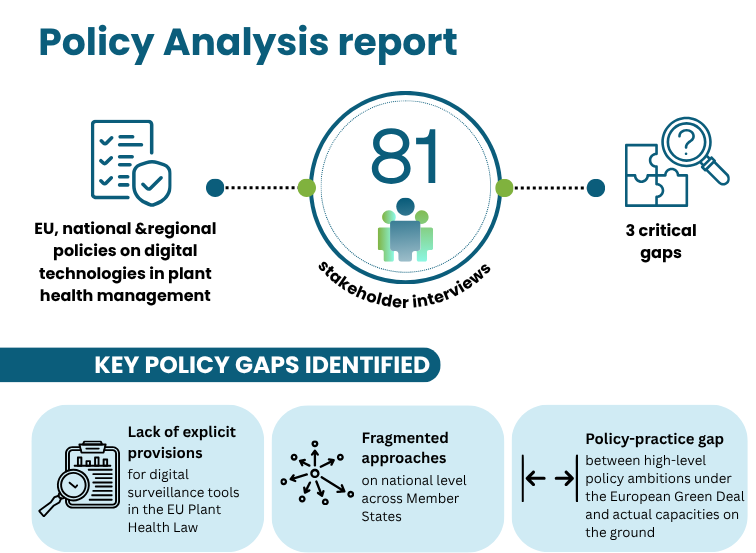
The Policy Analysis report, completed in June 2025, established the foundation for this work by mapping EU, national and regional policies on digital technologies in plant health management. Drawing on 81 structured stakeholder interviews and a review of legislative and scientific sources, the analysis identified critical gaps: the EU Plant Health Law lacks explicit provisions for digital surveillance tools; national approaches are fragmented; and there is a disconnect between high-level policy ambitions under the European Green Deal and actual capacities on the ground. These findings defined eight initial policy areas of concern that now guide the next phase of policy analysis.
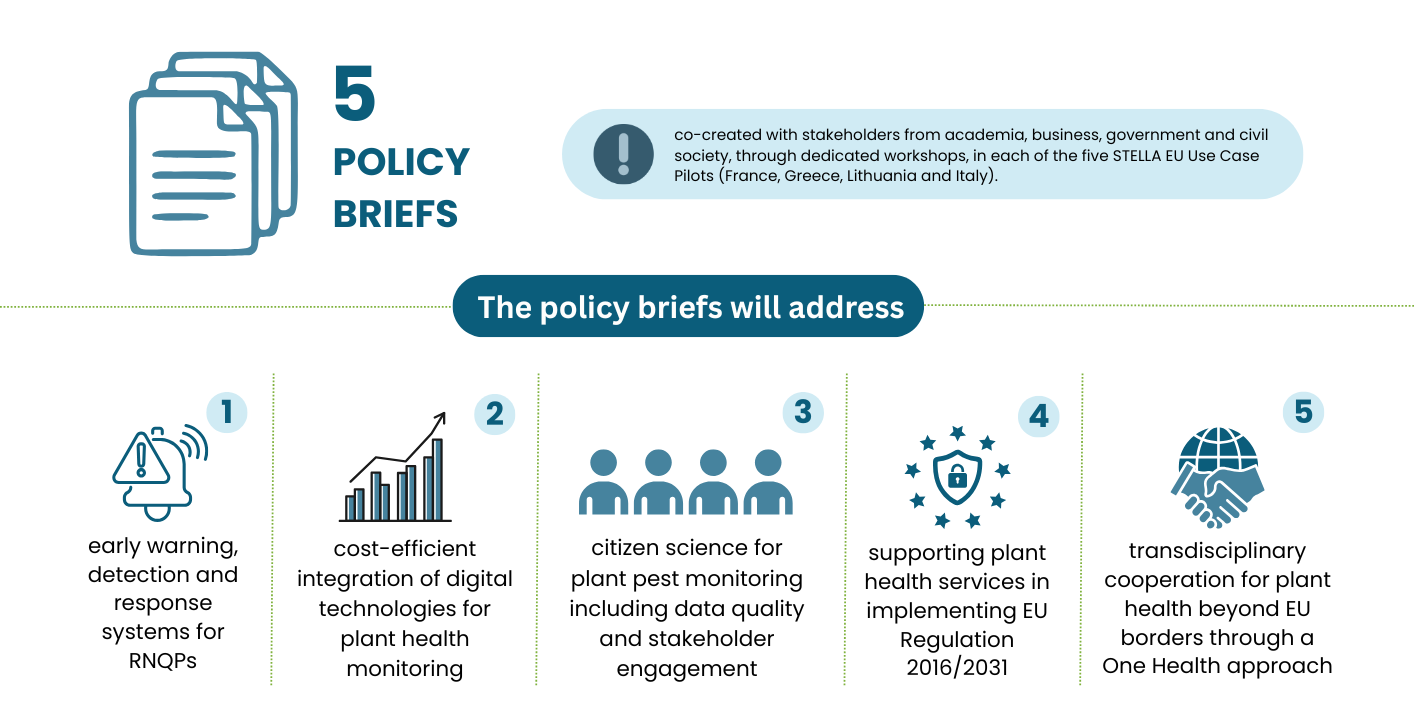
The development of “Policy Recommendations on Adoption of Digital Technologies” for plant health monitoring is now central to STELLA’s policy work. This effort progressively incorporates evidence from STELLA’s technical and pilot work packages and will deliver actionable policy recommendations and a guide for policy design by the end of 2027. Five policy briefs are being developed, co-created with stakeholders from
academia, business (farmers, foresters, agri-tech companies), government (NPPOs, regional plant protection services, CAP managing authorities) and civil society, through dedicated workshops, in each of the five STELLA EU Use Case Pilots (France, Greece, Lithuania and Italy). The policy briefs address: early warning, detection and response systems for RNQPs, cost-efficient integration of digital technologies for plant health monitoring, citizen science for plant pest monitoring (including data quality and stakeholder engagement), supporting plant health services in implementing EU Regulation 2016/2031, and transdisciplinary cooperation for plant health beyond EU borders through a One Health approach. In parallel, the Agricultural University of Athens is leading a Cost-Benefit Analysis to generate the economic evidence for the briefs, using return on investment, cost-benefit ratios and a Discrete Choice Experiment to value non-market ecosystem services.
This work is particularly relevant in light of the Commission’s proposal for the Common Agricultural Policy (CAP) post-2027, published in July 2025 as part of the Multiannual Financial Framework 2028–2034. The proposed CAP reform integrates the agricultural policy into the new National and Regional Partnership Plans, with at least €300 billion ring-fenced for income and crisis support. Importantly for STELLA, the proposal emphasises advisory services, targeted training and digital solutions as central tools for a competitive and sustainable agriculture. The new farm stewardship system, which replaces the current conditionality framework, will set requirements linked to environmental and climate objectives, where digital pest surveillance tools can add measurable value. Furthermore, complementarity across EU funding programmes is expected to bridge the digitalisation gap in rural areas, directly addressing a key barrier identified in STELLA’s policy analysis.
STELLA’s policy outputs are thus being developed amid significant regulatory evolution. The amended Plant Health Law, the CAP reform, and the broader EU digital and data legislation, including the Data Act, the Data Governance Act, and the AI Act, are fostering conditions for integrating digital tools into phytosanitary governance. STELLA’s five policy briefs, cost-benefit analysis, and upcoming Policy Roadmap will provide policymakers, authorities and practitioners with concrete, evidence-based guidance to leverage this momentum and ensure digital innovation in plant health leads to effective and inclusive policies.

